WokWave: A 10-Second Verb-Stack Commercial in Creative Studio
A two-line brief turned into a 10-second noodle commercial: the chat that tightened the timing, the eight-panel storyboard, the director's craft charter, and the prompts Produce made for it.
 By Yasiru Withanage7 min read
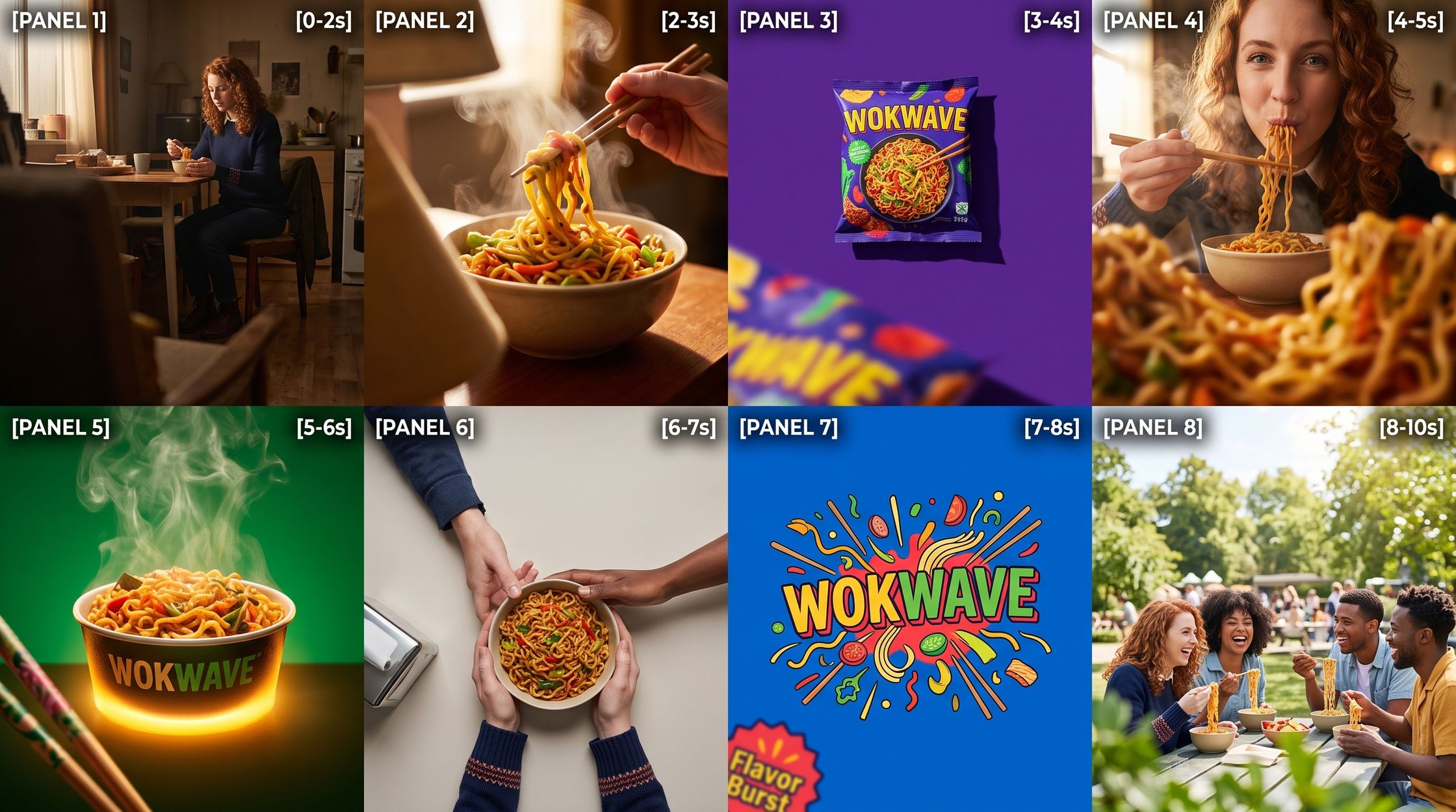
Every tutorial on this blog follows a real Creative Studio project end to end. This one is a 10-second commercial for a noodle brand called “WokWave,” built on the “Verb-Stack” format — one repeating spoken unit (“twist it,” “slurp it,” “share it”) cut at roughly one second per beat, alternating between live-action and hard-graphic worlds. It's a good project for showing how the pipeline handles an unusually dense brief: eight sub-second moments, one continuous ten-second render, and a real gap between what the panel proposed in chat and what the treatment actually shipped. Six real actions, in this order: chat, check the timeline, Send to the director, Review & edit, Produce, then paste the prompts in order. Here's exactly what happened at each one.
1. Chat with Vega
The actual ask was two lines. Everything after it in the same message was a full page-long shooting-format spec — the “Verb-Stack Format” — pasted in as reference material for the panel to follow, not part of the request itself:
I need a 10s commercial video. this video about noodle called wokwave.

The Verb-Stack Format
The message continued for several hundred more words — a full reusable shooting-format spec (camera rules, lighting, typography, a production checklist) pasted in as reference, not reproduced here.
The panel read the whole spec and came back with one concrete production note: at roughly one second per beat, the verbal units and product claims as originally written wouldn't fit without getting cut off, so it proposed tighter wording for several of them:
That's fantastic – I've synthesized the panel's input, and we're looking great on the structure and overall vision for your Wokwave spot! Everyone's aligned on leveraging the Verb-Stack Format for that dynamic, engaging feel within the 10-second timeline. The emotional arc from quiet to chaotic to communal is really coming through in the pacing.
The main thing to tighten up for production is the wording of the fast-paced verbal units and product claims in the montage. Since each moment is just one second, we need those lines to be super concise to fit perfectly without being cut off.
I've made those adjustments in the brief, so the timeline now looks like this:
Segment 1 — 10s (From quiet and contemplative to chaotic and energetic, ending in joyful togetherness.)
[0-2s] (~4 words fit) A lone individual sits at a table in a dimly lit room, holding a bowl of noodles, contemplating. — spoken: How do you Wokwave?
[2-3s] (~2 words fit) Live-action: A hand expertly twists noodles with chopsticks, steam rising. — spoken: twist it
[3-4s] (~2 words fit) Graphic: A vibrant Wokwave noodle pack isolated against a solid, saturated backdrop. — spoken: Bold flavors
[4-5s] (~2 words fit) Live-action: A person slurps a long strand of noodles with exaggerated gusto. — spoken: slurp it
[5-6s] (~2 words fit) Graphic: A macro shot of steam vigorously rising from a freshly prepared bowl. — spoken: Quick prep
[6-7s] (~2 words fit) Live-action: Two hands reach in from opposite sides of the frame to share a bowl of noodles. — spoken: share it
[7-8s] (~2 words fit) Graphic: Stylized text 'Wokwave' appears with a visual burst of flavor elements. — spoken: Always perfect.
[8-10s] (~4 words fit) A diverse group of friends or family gathered outdoors, laughing and happily eating Wokwave noodles together. — spoken: That's Wokwave.
With these precise timings and refined verbal units, the brief is now render-ready. You can hit Produce!
Worth noting rather than smoothing over: the treatment that actually got produced kept the original, slightly longer lines (“Ready in 3 minutes,” “Perfect every time.”) rather than the trims proposed above (“Quick prep,” “Always perfect.”). The panel's own word-budget math meant it didn't have to force the shorter versions through — see the Validate step below for the numbers.
2. Check the timeline
The whole spot is one ten-second timeline segment, pre-split into eight rapid moments — the “Verb-Stack” unit list turned into a shot-by-shot grid:
| Time | What happens | Spoken line |
|---|---|---|
| 0–2s | A lone individual sits at a table in a dimly lit room, holding a bowl of noodles, contemplating. | “How do you Wokwave?” |
| 2–3s | Live-action: a hand expertly twists noodles with chopsticks, steam rising. | “twist it” |
| 3–4s | Graphic: a vibrant Wokwave noodle pack isolated against a solid, saturated backdrop. | “Bold Asian flavors” |
| 4–5s | Live-action: a person slurps a long strand of noodles with exaggerated gusto, leaning towards the lens. | “slurp it” |
| 5–6s | Graphic: a macro shot of steam vigorously rising from a freshly prepared bowl of Wokwave noodles. | “Ready in 3 minutes” |
| 6–7s | Live-action: two hands reach in from opposite sides of the frame to share a bowl of noodles. | “share it” |
| 7–8s | Graphic: stylized text “Wokwave” appears with a visual burst of flavor elements. | “Perfect every time.” |
| 8–10s | A diverse group of friends gathered outdoors, laughing and happily eating Wokwave noodles together. | “That's Wokwave.” |
The timeline, as chat left it
Eight moments, ten seconds, matching the brief's own pacing exactly. Straight to Send to the director.
3. Send to the director
This is the step that turns a timeline into a production treatment: a locked cast, a shot-by-shot render plan, camera direction — and, for this piece, its own diagnosis of what's actually hard about it, before writing a word of the plan:
- Ensure each one-second shot registers as a distinct idea and action, preventing the rapid montage from collapsing into a single, illegible blur.
- Execute a three-part emotional arc from quiet intimacy to chaotic energy to communal joy within ten seconds.
- Make the product look genuinely delicious and appetite-inducing within a series of one-second, action-oriented shots.
- Make the alternating live-action and graphic worlds feel like a unified, intentional style rather than two clashing, incoherent pieces of creative.
With those named, it explained why the fix was one full-segment storyboard shot rather than eight separate one-second clips:
The brief provides a fixed, pre-timed 10-second sequence with multiple sub-second moments. A single, multi-panel storyboard shot is the only way to execute this structure faithfully, preserving the rapid cuts and emotional arc of the 'Verb-Stack' format within one renderable asset.
The cast came back with four characters — The Individual (the contemplative opener) plus three unnamed “Enthusiast” voices, each given its own fixed voice pin. In the treatment that actually renders, though, every single spoken line across all eight panels ends up attributed to The Individual — the three extra voices are pinned but never used. The video model still has no voice ID, so the one voice that does speak gets pinned as a fixed description and repeated verbatim across the whole ten seconds:
| Character | Voice pin |
|---|---|
| The Individual | Clear, mid-register, questioning tone, Standard American |
Voice pin — repeated verbatim across all eight panels
4. Review & edit — Validate
The treatment doesn't render on approval — it lands on a Review & edit screen, and every change there re-runs the same checks for free, no model call. Creative Studio budgets spoken word count at roughly 2.2 words per second of clip, so this ten-second shot gets about 22 words to work with. Add up all eight spoken lines above — “How do you Wokwave?”, “twist it”, “Bold Asian flavors”, “slurp it”, “Ready in 3 minutes”, “share it”, “Perfect every time.”, “That's Wokwave.” — and it comes to exactly 22 words. The original, un-trimmed lines were already on budget, which is why the treatment didn't need the shorter phrasing the panel had proposed in chat.
5. Produce
Only pressing Produce turns the approved treatment into something pasteable. Two things happen in order: a reference sheet for the one character whose face is actually on screen, then the single storyboard's image prompt and full render prompt.
The cast: one face, one voice, for the whole spot
Only The Individual is cast into the actual render — the three Enthusiast voices exist in the treatment's cast list but never appear on screen or in the reference set. Her reference sheet is what keeps face, hair and wardrobe consistent across every panel of the board:
Character reference sheet for The Individual, The contemplative opener. Female, 20-25, Has a thoughtful, expressive face with interesting features. Not a model., Simple, comfortable clothing, like a worn-in sweater.. Four views of the SAME person side by side on a plain neutral grey backdrop: full-body front, full-body back, full-body side profile, and a head-and-shoulders face close-up. Identical wardrobe, hair and proportions in every view. Even, neutral lighting. No text, no labels, no props, no background scenery.
One shot, eight panels, ten seconds
Because the brief pre-timed eight sub-second moments inside a fixed ten-second window, this entire spot is ONE storyboard shot, not eight separate clips — a single eight-panel board that gets animated straight through in order.
Reference images
- The Individual — reference sheet
Technical
- Aspect ratio
- 9:16
A clean storyboard board: 8 equal-size photographic frames arranged in a tidy grid, read left-to-right then top-to-bottom, frames sitting edge to edge. Label each frame with ONLY its panel number in the top-left corner and its time range in the top-right corner. NO captions, NO shot descriptions, NO camera notes, NO subtitles, NO overlay text and NO logos anywhere in or under any frame — only the photographic image plus those two small labels.

Consistent look across every frame: A mix of two distinct worlds. Live-action scenes (World A) are warm, saturated, and feature shaped daylight (side/back-lit) in cluttered, characterful interiors. Graphic scenes (World B) use hard directional keys on isolated subjects against solid, clashing, saturated backdrops. All shots use Z-axis dolly moves (whip, creep, settle), wide lenses for a close, in-your-face feel, and deep out-of-focus foreground objects to create parallax and depth.

Wokwave: Hot, steamy, colorful, well-garnished noodles in a bowl; also shown in packaging and being consumed. rendered identically in every frame it appears in — not restyled or re-labelled.

Use the supplied character reference sheet(s) for The Individual; the same face, hair, build and wardrobe in every frame.

SHOT 1 — 0-2s
A lone The Individual sits at a table in a dimly lit room, holding a bowl of noodles, contemplating. Minimal light creates a sense of stillness..
Slow dolly creep-in, warm, shaped side-light.

SHOT 2 — 2-3s
Live-action: A hand expertly twists noodles with chopsticks, steam rising. Focus on the texture and motion..
Whip dolly-in, macro, hard backlight to catch steam.

SHOT 3 — 3-4s
Graphic: A vibrant Wokwave noodle pack isolated against a solid, saturated backdrop..
Quick dolly-in & settle, hard, directional key light.

SHOT 4 — 4-5s
Live-action: A person slurps a long strand of noodles with exaggerated gusto, leaning towards the lens. Messy but satisfying..
Fast dolly-in (in-your-face), wide angle, warm, high-contrast light.

SHOT 5 — 5-6s
Graphic: A macro shot of steam vigorously rising from a freshly prepared bowl of Wokwave noodles..
Slow dolly-out (reveal), macro, intense backlight from below.

SHOT 6 — 6-7s
Live-action: Two hands reach in from opposite sides of the frame to share a bowl of noodles, implying camaraderie and connection..
Static (locked-off), soft, even top light.

SHOT 7 — 7-8s
Graphic: Stylized text 'Wokwave' appears with a visual burst of flavor elements, against another clashing saturated background..
Sharp dolly-pull-out, digital move. flat, graphic lighting.

SHOT 8 — 8-10s
A diverse group of friends or family gathered outdoors or in a lively setting, laughing and happily eating Wokwave noodles together. High energy and wide composition..
Steadicam arc & pull-out, wide angle, bright, sunny daylight.

Every frame is composed in 9:16, photographic (no illustration, no hand-drawn look), with consistent characters, wardrobe, colour palette and lighting throughout.
This is the image that gets animated in the next prompt — every panel, prop and background in the final ten seconds traces back to this one board, not to the video prompt's text.
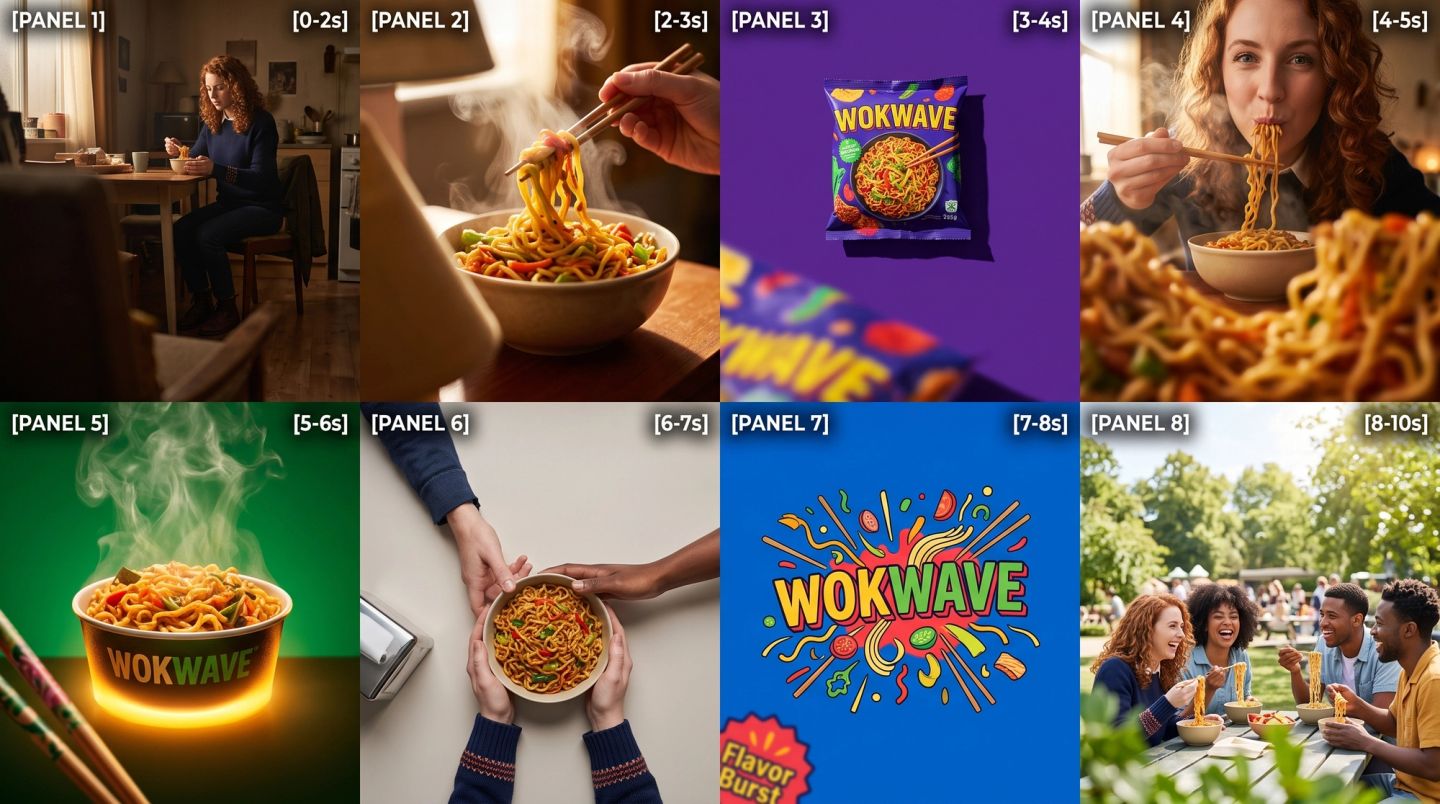
Reference images
 Storyboard image (generated above)
Technical
- Aspect ratio
- 9:16
- Duration
- 10 seconds
- Video engine
- Kling
Animate the storyboard as the final video, following its panels in chronological order. Treat each panel as the next moment of the same sequence, not as an image or layout to display. Preserve exactly the visual medium, art style, character identity, design, colours, environments, and composition shown in the storyboard and references. Do not convert or reinterpret the style. The output contains only the fully rendered scenes—never the storyboard, panels, borders, grid, page, or thumbnails.

The motion runs panel 1 (0-2s): A lone The Individual sits at a table in a dimly lit room, holding a bowl of noodles, contemplating. Minimal light creates a sense of stillness., SLOW DOLLY CREEP-IN / 35mm, f/2.8. Warm, shaped side-light.; then panel 2 (2-3s): Live-action: A hand expertly twists noodles with chopsticks, steam rising. Focus on the texture and motion., WHIP DOLLY-IN / 50mm Macro, f/4. Hard backlight to catch steam.; then panel 3 (3-4s): Graphic: A vibrant Wokwave noodle pack isolated against a solid, saturated backdrop., QUICK DOLLY-IN & SETTLE / 40mm, f/5.6. Hard, directional key light.; then panel 4 (4-5s): Live-action: A person slurps a long strand of noodles with exaggerated gusto, leaning towards the lens. Messy but satisfying., FAST DOLLY-IN (IN-YOUR-FACE) / WIDE ANGLE 24mm, f/2.8. Warm, high-contrast light.; then panel 5 (5-6s): Graphic: A macro shot of steam vigorously rising from a freshly prepared bowl of Wokwave noodles., SLOW DOLLY-OUT (REVEAL) / 100mm Macro, f/4. Intense backlight from below.; then panel 6 (6-7s): Live-action: Two hands reach in from opposite sides of the frame to share a bowl of noodles, implying camaraderie and connection., STATIC (LOCKED-OFF) / 50mm, f/2.8. Soft, even top light.; then panel 7 (7-8s): Graphic: Stylized text 'Wokwave' appears with a visual burst of flavor elements, against another clashing saturated background., SHARP DOLLY-PULL-OUT / Digital move. Flat, graphic lighting.; then panel 8 (8-10s): A diverse group of friends or family gathered outdoors or in a lively setting, laughing and happily eating Wokwave noodles together. High energy and wide composition., STEADICAM ARC & PULL-OUT / WIDE ANGLE 24mm, f/4. Bright, sunny daylight..

Featured subject — Wokwave (Instant noodles), rendered exactly as specified: Hot, steamy, colorful, well-garnished noodles in a bowl; also shown in packaging and being consumed.. Clearly visible: Prepared noodles (in a bowl); Wokwave packaging; People enjoying the noodles. Do not restyle, re-label or redesign it.

Character reference: the people are the ones in the supplied reference sheet(s) for The Individual — keep them identical to their sheet and to the board.

Voice casting — fixed for the whole piece, identical in every shot: The Individual (the woman in simple, comfortable clothing, like a worn-in sweater): Clear, mid-register, questioning tone, Standard American.

Spoken on the panels, in order: At 0-2s, The Individual (the woman in simple, comfortable clothing, like a worn-in sweater) says, "How do you Wokwave?" — only The Individual's lips move. At 2-3s, The Individual (the woman in simple, comfortable clothing, like a worn-in sweater) says, "twist it" — only The Individual's lips move. At 3-4s, The Individual (the woman in simple, comfortable clothing, like a worn-in sweater) says, "Bold Asian flavors" — only The Individual's lips move. At 4-5s, The Individual (the woman in simple, comfortable clothing, like a worn-in sweater) says, "slurp it" — only The Individual's lips move. At 5-6s, The Individual (the woman in simple, comfortable clothing, like a worn-in sweater) says, "Ready in 3 minutes" — only The Individual's lips move. At 6-7s, The Individual (the woman in simple, comfortable clothing, like a worn-in sweater) says, "share it" — only The Individual's lips move. At 7-8s, The Individual (the woman in simple, comfortable clothing, like a worn-in sweater) says, "Perfect every time." — only The Individual's lips move. At 8-10s, The Individual (the woman in simple, comfortable clothing, like a worn-in sweater) says, "That's Wokwave." — only The Individual's lips move. Spoken dialogue only, exactly as written and only from the named speakers. No narration, no voiceover.

Every person on screen who isn't the named speaker keeps their lips closed and still.

Rendering constraints: Clean, unmarked frame — no watermarks, no captions, no subtitles, no UI overlay. Surfaces and signage stay free of lettering. Solid objects — furniture, walls, props — are impenetrable: people move around them, never through them, and every contact carries natural weight. Objects stay put unless someone deliberately moves them. Gravity behaves normally and camera moves stay smooth and coherent.

Aspect ratio 9:16. Duration 10 seconds. Ends on a cut.

Opening frame constraint: directly with the fully rendered scene from panel 1, already in motion. The storyboard itself must never appear, and there must be no panel, page, thumbnail, split-screen, or storyboard-style transition.
The prompt runs all eight panels in order inside one continuous animation — the model never sees the storyboard grid itself, only the instruction to animate straight through it.
6. Follow the prompts in order
Same rule as any storyboard project: the storyboard image prompt goes into the image model first — Nano Banana, here — and the eight-panel board it returns becomes the reference image for the render prompt in Kling. One image, one video, and the ten-second spot is done.

About the author
Yasiru Withanage — Principle AI Engineer, Founder PromptMotion
Yasiru Withanage is the founder of PromptMotion and an AI engineer with 6+ years of experience in computer vision, generative AI, and LLM applications. He builds AI tools and workflows that help creators generate professional prompts, images, and videos faster, and shares practical AI techniques through PromptMotion.
Want prompts like these written for your own brief?
Paste your notes. PromptMotion writes the prompt.
Try it free